**Keiyo Eyes New Growth Opportunities in Kumamoto as President Chen Chen-hsing Meets with Japan’s Minister of Land, Infrastructure, Transport and Tourism Yasushi Kaneko**
Keiyo Eyes New Growth Opportunities in Kumamoto: President Chen Chen-hsing Meets with Japan’s Minister of Land, Infrastructure, Transport and Tourism Yasushi Kaneko
Shaping the Future Vision for the KAiTA Project
[Tokyo, Japan] December 5, 2025
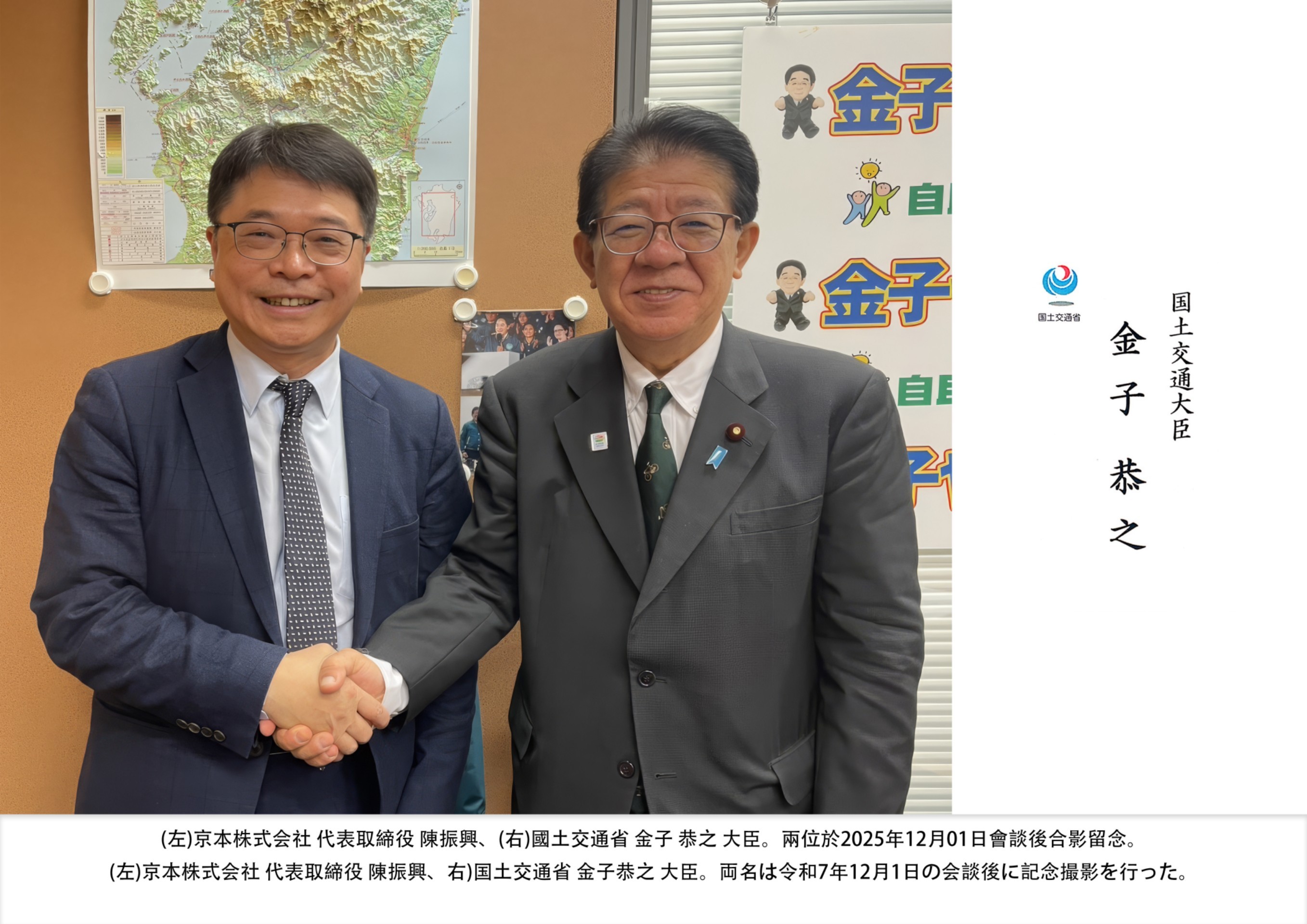
Chen Chen-hsing, President and Representative Director of Keiyo Co., Ltd., recently met with Yasushi Kaneko, Japan’s Minister of Land, Infrastructure, Transport and Tourism, in Tokyo. The two sides held in-depth discussions regarding Keiyo’s “KAiTA – Kumamoto AI Technology Arena” project, an artificial intelligence technology park being developed in Ozu Town, Kumamoto Prefecture.
The meeting was held on the morning of December 1, 2025, at the Members’ Office Building of the National Diet. Minister Kaneko expressed strong support for the project’s overall vision and development direction. Following the discussion, he also indicated his intention to support the initiative and emphasized that he would provide necessary assistance in the future to help facilitate the successful advancement of the project.
Minister Yasushi Kaneko is originally from Kumamoto Prefecture and has long been involved in areas including regional revitalization, national infrastructure resilience, and transportation infrastructure. He has closely followed the significant changes and emerging opportunities brought to Kumamoto by the expansion of the semiconductor industry, while also working to advance policies addressing the accompanying challenges in transportation and urban planning.
The KAiTA Vision
At a time when the global technology landscape is undergoing rapid transformation, the establishment of “KAiTA – Kumamoto AI Technology Arena” represents a significant step in positioning Kumamoto beyond its traditional role as a science and technology hub in Japan’s Kyushu region and toward becoming a strategic center in the rebalancing of Asian supply chains. Building on its semiconductor industry, Kumamoto is gradually developing an integrated ecosystem encompassing wafer manufacturing, advanced packaging, materials supply, equipment manufacturing, AI training infrastructure, and smart manufacturing facilities. Taiwanese companies bring deep expertise in talent development, manufacturing processes, management, AI applications, and mass production, creating strong potential for synergy with Japan’s strengths in precision engineering, equipment technologies, and high-quality manufacturing. This positions Kumamoto as a promising strategic technology hub for Taiwan-Japan technological collaboration.
The development of the KAiTA Project represents more than cooperation in equipment, facility construction, or talent mobility. It reflects the shared determination of Taiwan and Japan to build the next generation of technology centers. The platform will be guided by four core pillars: “Shared R&D,” “Smart Manufacturing Standardization,” “Cross-Border Talent Development,” and “Advanced Technology Validation.” These initiatives are designed to enable companies to validate the integration potential of semiconductor processes while minimizing R&D and pilot-production costs, ultimately shortening the overall timeline from technological concept to mass-production deployment.
Looking ahead, KAiTA will further connect Taiwan’s semiconductor supply chain with Japan’s manufacturing strengths and bring together additional international technology partners to establish a sustainable environment for technological innovation. The park will also provide comprehensive support for international teams establishing operations in Japan, including shared equipment, technical exchange, accelerator resources, talent matching, and testing facilities. Through these capabilities, KAiTA aims to become a critical gateway for companies seeking to expand into the Japanese and global markets.
As global demand for AI, semiconductors, and smart manufacturing continues to rise, Kumamoto’s science and technology ecosystem is expected to play an increasingly important role in the international industrial value chain. The launch of the KAiTA Project signals a new era of Taiwan-Japan technology cooperation and a shared ambition to build the next global center of innovation. KAiTA represents more than the name of a technology park; it symbolizes a new beginning for cross-border collaboration, industrial advancement, and technology-driven co-creation.