
Reshaping Asia’s Technology Landscape: Taiwan and Japan Forge a Strategic Alliance of National Importance
Reshaping Asia’s Technology Landscape: Taiwan and Japan Forge a Strategic Alliance of National Importance
Diet Member Nobuchiyo Kishi Endorses the Vision, Positioning KAiTA as a Strategic Core of Taiwan-Japan Semiconductor Cooperation
[Tokyo, Japan] December 5, 2025
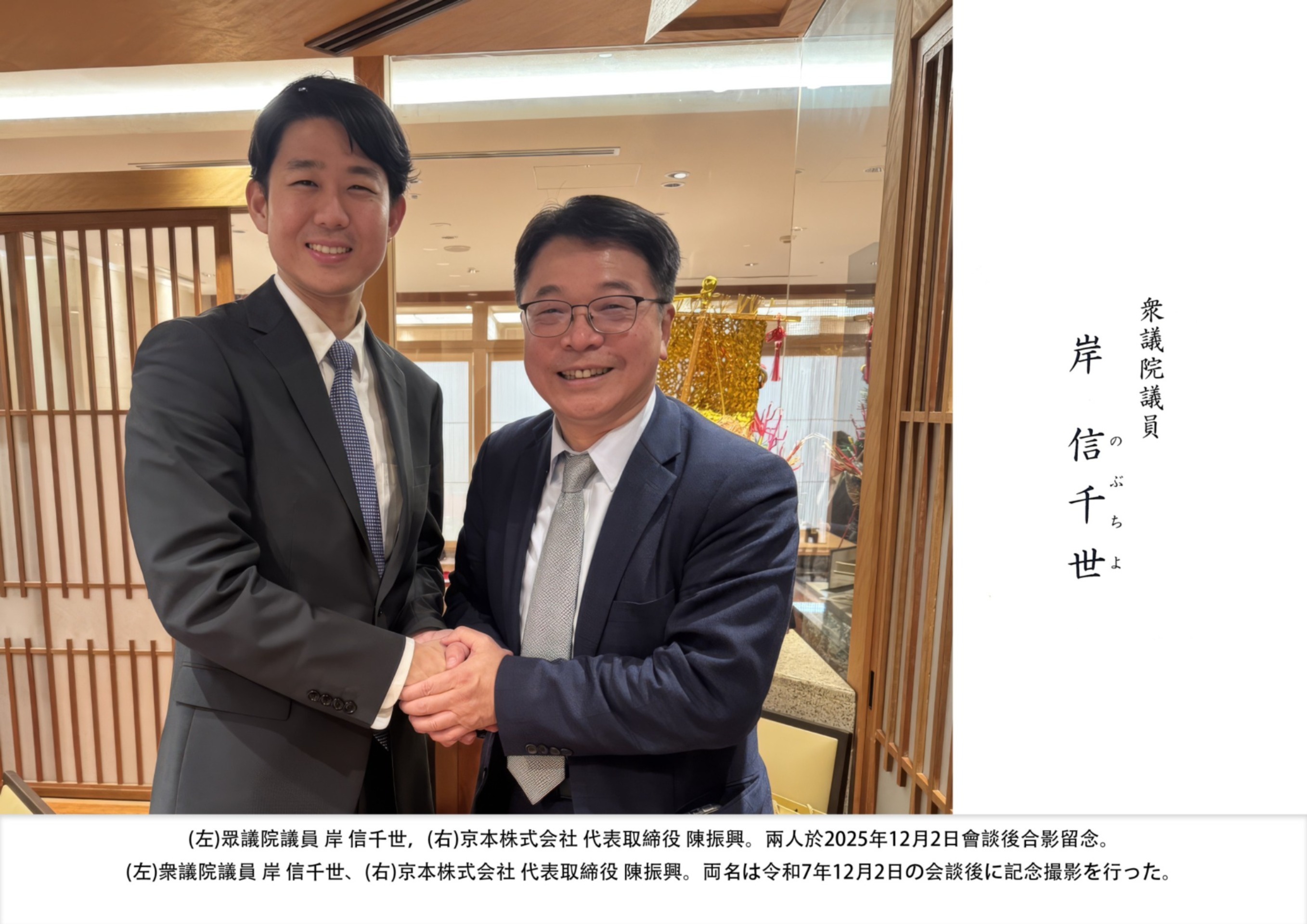
President Chen Chen-hsing of Kyoyo Co., Ltd. met with Nobuchiyo Kishi, a member of the House of Representatives from the Liberal Democratic Party, in Tokyo on the afternoon of December 2. The two sides exchanged views on the Kumamoto AI Technology Arena (hereinafter referred to as the KAiTA Project). The meeting focused on key issues including regional revitalization, technology supply chain development, AI talent development, and international cooperation.
During the meeting, President Chen Chen-hsing presented KAiTA’s comprehensive development blueprint, explaining how the integration of cross-disciplinary technologies spanning AI, semiconductors, smart manufacturing, and regenerative medicine could transform Kumamoto into an internationally competitive smart technology hub. Diet Member Kishi expressed strong support for KAiTA’s strategic direction and indicated that he would provide necessary support and assistance to accelerate the project’s implementation and development.
■ KAiTA — A Next-Generation Technology Hub Connecting Technology, Communities, and the Global Economy
KAiTA is built around the concept of a “Kumamoto Division of a Taiwan Technology Park,” leveraging the complementary strengths of the Taiwan-Japan industrial ecosystems and focusing on four key areas:
- Artificial Intelligence (AI) and smart city systems;
- Semiconductor R&D, design, and supply chain applications;
- Advanced Manufacturing × Renewable Energy industrial clusters;
- A core manufacturing base for the AI-enabled biomedical industry chain.
The planned development includes R&D buildings, smart warehouses, an education and training center, corporate accelerators, and pilot production lines. In coordination with surrounding urban redevelopment initiatives, the project will establish comprehensive transportation infrastructure and living amenities, with the goal of transforming Kumamoto into an innovative city that combines technological momentum with a high quality of life.
■ Diet Member Nobuchiyo Kishi: KAiTA Closely Aligns with Japan’s Technology Strategy
Diet Member Nobuchiyo Kishi, who has long focused on regional revitalization and digital development, highlighted three major strategic values of the KAiTA Project:
- Strengthening Technological Self-Reliance and Industrial Competitiveness: AI and semiconductors are critical to Japan’s future economic and technological capabilities. By bringing Taiwan-Japan industrial supply chains and R&D capabilities together in Kumamoto, KAiTA can help strengthen Japan’s capacity to respond independently to growing global technology demand.
- Advancing Regional Revitalization and Balanced Development: Establishing an internationally oriented technology park outside major metropolitan areas can create high-value technology jobs while driving comprehensive upgrades to infrastructure and surrounding commercial areas, contributing to more balanced regional development.
- Advancing Digital Talent Development: KAiTA’s planned education center and university-industry collaboration mechanisms can serve as an important base for Japan’s Digital Talent Development initiatives, helping cultivate critical talent in AI, data science, semiconductor engineering, and related fields.
■ Conclusion: Building a Future-Oriented International Technology City
Diet Member Nobuchiyo Kishi noted that KAiTA combines the three strategic pillars of “National Policy × Industrial Demand × Regional Revitalization,” positioning the project as a key platform connecting international R&D resources with global markets. As the Japanese government continues to expand technology investment and promote international cooperation, KAiTA is emerging as a high-profile model project with the potential to become a core hub for Japan’s next generation of innovation and advanced technologies.
Looking ahead, KAiTA will promote closer integration among industry, academia, and research institutions, support the development of advanced technology talent, and stimulate regional economic growth, opening a new chapter in Taiwan-Japan technology cooperation.